

DOGE's Cuts Increased Federal Spending By 6%
Elon Musk's Government Efforts To Slash Spending Had The Opposite Effect

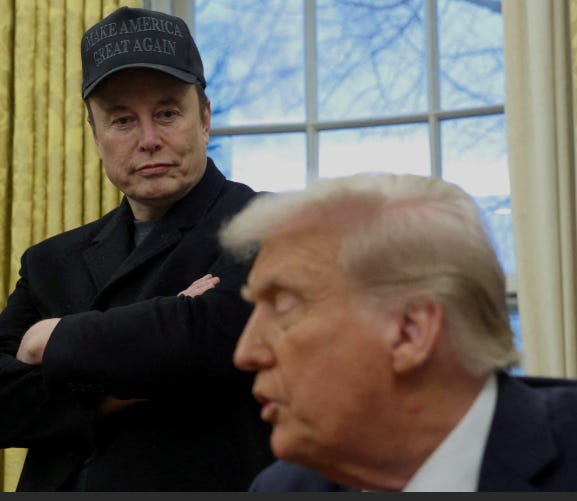
Elon Musk and Vivek Ramaswamy promised DOGE would lead to a leaner, cheaper American government that would “cut $2 trillion” from the Federal budget. However, according to recent data and an analysis by the Brookings Institution’s Hamilton Project, the actual results tell a very different story: the workforce has been gutted, humanitarian projects have been erased, and spending is up.
The central mandate of DOGE was to slash the federal deficit by rooting out “waste, fraud, and abuse.” Yet, as of late December 2025, federal outlays have not only failed to drop—they have surged. According to the Hamilton Project’s real-time expenditure tracker, federal outlays rose from roughly $7.135 trillion to $7.558 trillion over the last year.
This represents a roughly 6% increase in government spending, directly contradicting the “chainsaw” narrative Musk popularized. While DOGE targeted high-profile, low-cost line items like the Corporation for Public Broadcasting, USAID, or international grants, these amounted to rounding errors in a budget dominated by “autopilot” programs.
It also normalized the Federal government ignoring Congressional appropriations, allowing unelected bureaucrats like Russell Vought to make unilateral and illegal decisions about what will and won’t be funded.
While Musk failed to move the needle on total spending, he succeeded in creating the largest peacetime workforce reduction in American history. Data indicates federal employment has been slashed by approximately 271,000 positions, down 9% slump since January 2025.
Entire departments have been shuttered or merged, and “DOGE-bros” (private-sector tech workers embedded within agencies) became the new faces of federal administration.
However, experts from the Cato Institute and other fiscal watchdogs note that cutting staff does not automatically cut spending. In fact, the “brain drain” of experienced civil servants reportedly led to administrative chaos, potentially increasing costs through mismanagement and the need for expensive private contractors to fill the gaps.
Roughly two-thirds of the budget is comprised of “mandatory spending”—Social Security, Medicare, and interest on the national debt.
Mandatory Programs: Musk and the Trump regime attempted to make cuts to Social Security through the Big Ugly Bill, resulting in an additional tax cut for seniors that many believe will drain Social Security trust funds and lead to cuts in the future.
Interest Rates: The national debt continues to climb, interest payments continue to be paid, and what we owe currently stands at over $38.5 trillion
Congressional Power: Ultimately, the “power of the purse” resides with Congress, and therefore the people through our elected representatives. The Federal government has limited power to make cuts (as it should be)
DOGE also targeted the DoD, with Hegseth proudly announcing $5.1 billion in spending cuts last April. But a report from the Government Accountability Office discovered the full cost of developing and deploying the Sentinel ICBM, slated to replace the Minuteman III missiles that have remained on watch since 1970, will balloon to “approximately $170 billion” after the Air Force realized the new missiles could not use legacy Minuteman III silos.
Trump has also blathered all year about the “F-47”, a next-generation fighter plane that is projected to cost upwards of $20 billion to develop. Now he’s promising a “golden fleet” of new battleships, which military.com says are “obsolete”. The cost hasn’t been announced officially, but experts believe it would be somewhere in the neighborhood of $15 billion each.
DOGE also made a series of expensive mistakes, some of which spawned lawsuits due to haphazard actions that did irreparable harm or required experts to swoop in and fix the errors. All of this resulted in government spending that wouldn’t have occurred otherwise.
Elon’s final tactic was to lower the predicted savings DOGE would bring, settling on $150 million. This was a far cry from the $5000 DOGE checks he and Trump promised in February.
Further complicating the narrative is a scathing report from the New York Times suggesting that DOGE’s self-reported “savings” were largely theatrical. The report found that 28 of the top 40 savings claims made by the department were either inaccurate or outright false. For instance, DOGE claimed billions in savings from “terminating” defense contracts that, upon closer inspection, were still active and fully funded.
Cuts to programs like USAID may have “saved” money on paper, but will do long-term, systemic damage to the United States’ ability to project soft power across the world. This harms our intelligence networks, our diplomatic stance, and has caused hundreds of thousands of deaths, according to a report from Harvard.
While Elon was able to use DOGE to fire tens of thousands of workers, he could not “delete” our financial obligations. All he’s done is make us weaker while spending more and causing issues that actual experts must solve.
It was never an honest cost-cutting venture to begin.
You mean the guy who is about to become the world’s first trillionaire by siphoning off the money of investors and taxpayers didn’t actually save any money? Huh.